
What 99.9% of authors don’t know.

What 99.9% of authors don’t know.

​Why I see so many good authors fail.

Book publishing is a creative pursuit. Writing a book is creative. Designing a book cover is creative. Marketing a book is creative. Or is it?

Book publishing is like construction.

Architect Jørn Utzon designed the Sydney Opera House. He used his creativity but within a constraining framework of physical laws. He designed the Opera House making sure it could withstand weather conditions, suited the geology and would not collapse under its own weight. In other words he couldn’t ignore the laws of the environment, geological realties and the law of gravity. These laws are immutable – these laws are rooted in science.

When you enter the Sydney Opera House you certainly don’t feel its about to collapse. It’s a great experience.

The laws of successful book publishing.

New authors who come to me wanting to self-publish know little about what I call the immutable laws of publishing. Full knowledge and understanding of these laws takes many years. I’ve leaned some of these by trial and error (a tough way to learn). And some by being mentored by some of the best in the business.

Unfortunately many authors focus on their creative prowess while at the same time being completely ignorant of the science of book publishing.

Here are just a couple of these laws that I will then summarize in a single mega-law.

Law No. 1  Design a book cover for the market not for the author. Books that fail often do so because of a poor cover design. Poor cover designs are usually dictated – often in fine-grain detail – by the author (who might be publishing their first ever book). Green Hill’s lead designer has personally designed almost 1,000 books – does she understand the law of book cover design? Yes, she certainly does.

Law No. 2 Editing is important. This is very similar to Law No. 1. While writing is a creative pursuit, an experienced editor will use their skill and experience to make the manuscript better (in many cases superior). Authors often break this rule pushing-back on the editor with “I don’t want my writing changed” or the old classic “you’ve removed my voice”.  There are immutable laws of good writing including structure and grammar that when violated are done at the author’s peril.

The mega law Successful book publishing is both art and science.

If you are a new author leave the science to the publisher and their staff i.e. book designers, book editors and book marketers. These professionals will approach the publishing of your book based on their hard won knowledge of the science shaped by empirical evidence. Publishing a good book is much about science.

Understand the ‘mega-law’ – only then will you improve the chance of your book’s success!

David Walters

Director, Green Hill Publishing

Success in self-publishing – it’s more complex than you think.

Success in self-publishing – it’s more complex than you think.

Photo by Jungwoo Hong on UnsplashSuccess in self-publishing – it’s more complex than you think. There are many reasons to write a book, and there are just as many ways to gauge how successful your book is.

Defining success by how many books are sold is a crude measure. ‘Success’ is really whatever the author wants to achieve, and many don’t care about publishing a bestseller or getting rich.

Some authors write and publish books and drive business to their professional practice, using the book as a business card of sorts. One of our authors sold just 392 copies of her book and made over $2,000 in profit directly from those sales. But from those sales she gained three new clients in just the first year of publishing her book. ­Those new clients together spent almost $90,000 annually on services provided by her company.

Book to assist self published authorsEven still, monetary success doesn’t have to be the only form – recognition from peers is just as valid a way to measure the success of your book. Another author we’ve worked with wrote a family history in the weeks following a near-death medical episode. ­The book was launched at a family reunion and received a standing ovation.

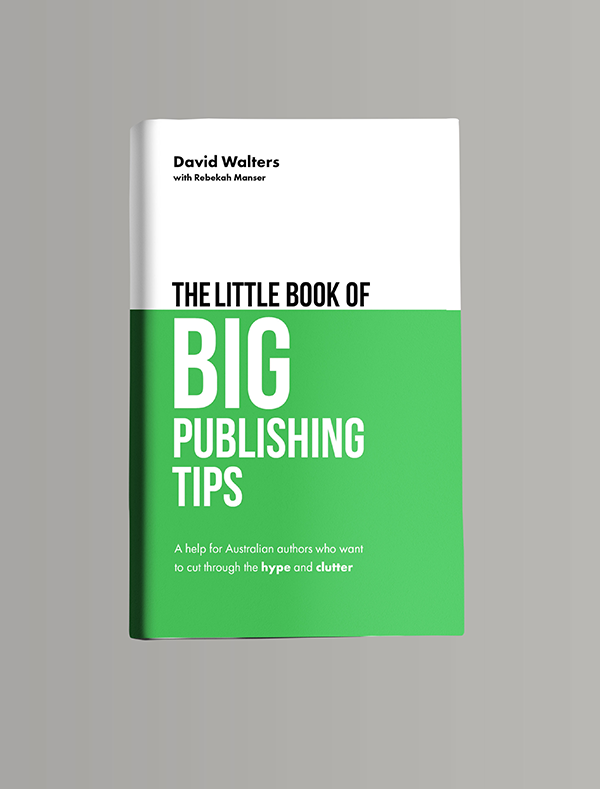
Want to read more? This excerpt is rewritten from our Big Book of Little Publishing Tips. Enquire with Green Hill Publishing today and get your copy.

Is the medium always the message?

Is the medium always the message?

Pile of books with differing quality print

Photo by Mahendra Kumar on Unsplash

Is the medium always the message? Publishing a book is not just about graphic design. A book is so much more than the visuals – it is also about touch.

Print remains the most universal and popular format for publishing a book. Despite the rise of audiobooks and ebooks there are more books printed each year in the history of planet Earth. And that’s where paper comes in.

Paper is a major variable in determining the print price of any author’s book. Depending on the paper type, it can add as much as 100% to the print price (regardless of whether it’s full-colour printing or just black). As dealt with in a previous book publishing blog, choice of production quality (including the paper) can destroy the economic viability of any project.

If you are doing a business book or a work of fiction, we always recommend using a budget paper stock so there is enough profit margin, i.e. retail price minus cost of production.

If it is an art book or poetry, then you can consider high quality paper. As Marshal McLuhn famously said “the medium is the message? In book publishing this might mean that a book is considered in its totality – the words, illustrations, the binding, and the paper.

In my mind, the jury is still out on McLuhan. Is what he said true in every situation? My emerging view is for fiction and many non-fiction genres (where the content and written word has primacy) the medium is not the message. Print cheap and profit.